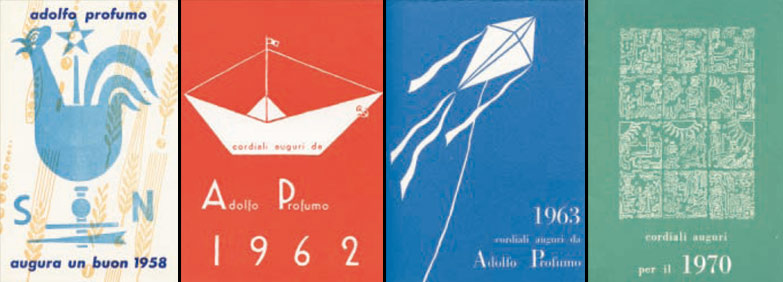
A critical anthology – The Nineteen seventies
Translated from the Italian originals. The press links below lead to the original articles in Italian.
Gazzetta del Lunedì, 6 December 1971
Giovanni Profumo at the Galleria Coin d’Art. In the presence of His Excellency Dr Rizzo, Prefect of Genoa, his gracious wife and numerous guests, collectors and friends, Giovanni Profumo’s solo exhibition of 38 of his most recent works was opened.
The magical, evocative effect of the colours with which the artist builds his singular landscapes, the luminosity of the transparencies, the harmony of the architectural perspective and his skill in handling paint place these works among the most significant of our time.
Profumo has twenty solo exhibitions to his name, and an exhibition is currently under way at the “Ur Nina” gallery in Damascus, Syria, opening the events dedicated to the international art gathering in Damascus.
M. B.
Gazzetta del Lunedì, 6 December 1971
L’Espresso, 7 March 1971
Exhibitions: Ulrike Eberle – Giovanni Profumo – Rome, Galleria Numero, via Principessa Clotilde 1
Five different ways of considering art as a constructive operation. Ulrike Eberle and Giovanni Profumo are exhibiting together at the Galleria Numero.
Giovanni Profumo, a 35-year-old Genoese who has been working in Rome for two years, has returned to figurative landscape painting after an abstract phase. These are landscapes painted without reference to a motif, invented according to the constructive possibilities of monochrome planes that the palette knife defines and organises on the canvas: a position close to that of some of De Staël’s figurative paintings.
L’Espresso, 7 March 1971
Sandra Orienti, Il Popolo, Saturday 30 January 1971
Art exhibitions: the pretext of nature
Giovanni Profumo, on the other hand, at the Numero gallery, seeks a harmonious relationship with the natural world – all the more harmonious as its forms are built through a formal abstraction strengthened by the incisive cut of the outlines and the dense resonance of the colour.
Sandra Orienti
Il Popolo, Saturday 30 January 1971
Luciano Marziano, 1971
Landscape and nature are words inflated with gratifying echoes by a long romantic tradition that dies hard. And yet landscape and nature are around us, they surround us, they assail our visual horizon and our levels of consciousness; so we are allowed to establish a truthful relationship with them by recovering them within the dimension of art.
This is the context of Giovanni Profumo’s research; his relationship with these realities has not always been calm and harmonious. There was even a moment when the abstract turn came as a pause, as a subtler capture of rhythms and structures. But the experiment was broken off, almost out of awareness of a sense of escape which, while it indulged a certain hedonistic formal acquiescence, did not heal the reasons for an old remorse – one that could be exorcised only by testing a reality filtered through the mechanisms of the psyche, not as an idealistic fact but as the reflection of an existential condition. At this point a selective operation is triggered, determined and imposed by the physical and spiritual presence in the world of the artist Profumo, who has consumed and still consumes the experience of contemporaneity, of living today, of incommunicability, of solitude – almost a spirit of the age which, from the spiritual level, tends to pass also onto objects, onto things and onto nature: no longer wild, picturesquely formless nature, but nature attacked by the woodworm of “progress”, which always comes at a price.
And so the lines of the landscape and its outlines become rational, meadows and fields appear tended even in their most remote, lunar and isolated recesses; it seems as if some mysterious intervention had changed their soft, graceful shades and recast them in primary colours cut into clean fields. And this Id, this unknowable that in Profumo’s canvases casts a vivid, steady light allowing no digressions even in favour of the dreamlike mystery of the Surrealists, but aiming rather to eliminate any suspicion of lyricism represented by the trees, reconstitutes a new reality that may even reach the limits of the artificial; as a consequence, a new way of seeing is recovered and the demands of the material take shape in mysterious flowers emerging from those mental places.
Giovanni Profumo lives this tragedy and, in a progressive reduction to essentials, rediscovers the substance of the real and a cathartic answer to his anxieties as a modern man.
Luciano Marziano, 1971
La Nazione Umbra, Friday 9 March 1973
Profumo’s exhibition
Fresh from his successes abroad, the painter Giovanni Profumo is now presenting a solo exhibition in Città di Castello, at the “Il Pozzo” modern art gallery, which is truly one of the most significant of those staged this season.
The works on show include some twenty oil paintings and a few refined drawings, which reveal the future developments this artist’s formal and ideological research might take. Looking at these works, one is immediately struck by the painter’s truly refined technical ability and stylistic skill, which pass through a tonal research so careful and so deep that it makes us think he has thoroughly studied the importance of colour in the works of the old masters. Indeed, his tonal research is so considered and so calibrated that he appears to us as a “true archaic of colour”.
Profumo’s expressionism unfolds along an arc that could paradoxically find its origins in Cubism and, through Futurist and Surrealist experiences, be summed up in a new concept, both of expression and of idea – a concept for which we would like to find a new name, to mark the new path he opens through a kind of “esoteric symbolism”.
In every work by this painter there is an idea. And one immediately understands that the things he wants to tell us are important. Certainly he says them with irony, but he gives us the chance to read his painted pages until we find ourselves in them: the society we live in, our time, history and the universe, including the cosmic one, all belong to the background of Profumo’s works. Some of them even take us back to Beckett’s theatre, not only for their irony and the fullness of their unnarrated pauses, in which anything can be imagined, but also for structures that may recall the world of Beckett’s apocalyptic silences – which in Giovanni Profumo (and this is his novelty) are not the expression of a world falling apart, but the premise and certainty of a possible catharsis.
La Nazione Umbra, Friday 9 March 1973
Città di Castello local news
Alice Schweitzer, 1973, Galleria Il Pozzo
The contest between harmony and invention. These well-known words, which Vivaldi gave as the title to a set of concertos, have an emblematic value for Giovanni Profumo: they have always been the ground and substance of his inspiration, and at the same time an ideal goal.
For an artist, trying to resemble oneself is a vital condition, as it is for a musical instrument to produce the sound for which it was made. If this is true for every human being, for an artist it can take on the scale of a drama. Eliot writes that past time and future time allow but little consciousness, while the world moves, full of appetite, along its asphalt roads; and that shrill voices – scolding, mocking or merely chattering – always assail the words, which strain, crack and sometimes break under the burden and the tension. It is a hard and misunderstood battle, but there is a still light at the still point of the turning world.
Today Giovanni Profumo has won this still point, at the cost of laborious research. “What do I care if one of your twos plus one of your twos makes one of your fours?” Beneath the slightly polemical tone of this remark by Profumo lies the now serene awareness that his own particular path must be sought beneath the contingent, or above it. Not outside reality, but in an ability to see reality without habit and without patterns, giving free rein to his imagination as a poet and an epigrammatic storyteller.
Harmony and invention: two non-divergent motifs that sum up the whole commitment of Giovanni Profumo’s work. “For some years now the notion of progress has been dead. Today’s problems are problems of change of state, of transmutation. A form of intelligence open to totality has become necessary” (Pauwels and Bergier). It is Teilhard de Chardin’s “planetary vision”. There is no point in lingering over positions of research for research’s sake, in a whirlwind spinning around ideological disorientation that only masks spiritual emptiness. For those who can see, the change has already happened. And one senses in the air a need to win back a spiritual dimension denied for too long. Giovanni Profumo is a conscious interpreter of this atmosphere and expresses it by creating, in forms of rugged beauty free of base emotional vibrations, a world in which tensions are indeed suffered, but also overcome and resolved in the name of a constructive order that is at the same time a moral lesson.
A formal harmony, then, that reflects a precise ideological intention, in its invitation to consider more broadly the possible solutions for these restless times of ours, in which we all feel – though perhaps we are not – on the brink of catastrophe. Still within this dimension, in his paintings with the most explicit symbolism and the most topical themes, the artist, following his “fabling and playful” imagination, seeks to exorcise a form of anxiety imposed on us without leaving any alternative – an anxiety that Profumo, “a poet of meditation”, as one critic called him, overcomes with the sometimes biting humour of a solitary figure who brings into this reality the gaze of the contemplative, enriched by knowledge gained elsewhere, “because,” he says, “I have been to the point where parallel lines meet.”
Alice Schweitzer, 1973,
Galleria Il Pozzo
Giorgio Calcagno, 1974, Galleria Centrarte Falanto
Had Giovanni Profumo chosen the written word, he would have been an author of metaphysical tales, in the great line of fantastic-rational literature that rises from Kafka’s unconscious forebodings to the final illuminations of Borges. But Profumo’s means of expression is the image, his way of communicating is above all visual; and there, in the closed rectangle of the canvas, he chose to throw his dice and develop all their possible combinations, between the play of chance and the law of necessity.
His paintings can be looked at from the outside, grasping their carefully studied relationships of light, or recognising the volumetric weight of the colour, which is perhaps the most characteristic feature of this painting. But above all they must be observed from the inside, entering the world the painter has enclosed in them, beneath or beyond the stroke of his palette knife.
They are paintings that imprison a story of decisive values, sometimes contradictory, always problematic, and they must be allowed to tell it. In those lines, as geometric as they are provisional, into which he has broken down his vision of the universe, his windows open onto sudden sources of light, his moons float in impossible and real skies, his hourglasses mark a time different from man’s present time, and therefore all the more secretly human.
Giovanni Profumo’s painting moves between the need for methodological rigour, which seeks expression in mathematical formulas, and an equally deep need for freedom, which must leap beyond those formulas – seeking, as a poet from his own region, Eugenio Montale, writes, “la maglia rotta nella rete – che ti circonda” (the broken mesh in the net that surrounds you). The fundamental structure in Profumo’s work is precisely that of the net, cast from outside; but the true meaning of his canvas lies in the “broken mesh”, which opens up a light from within.
The world glimpsed by the painter, like the poet’s, is a matter of following a wall topped with sharp shards of bottle glass, and Profumo seeks no useless, digressive consolation in marginal escapes. But unlike the poet he seems to know decisive ways out – provided one has the difficult virtue of looking for them and the even more difficult courage of pursuing them. In his “harsh and essential” landscape, the sky may be closed upwards, where a lazy eye used to look for it, following the patterns of a tired tradition; but it opens confidently downwards, according to a new anthropological vision that seems to have heeded the lesson of the “nouvelle théologie”. Even if God is free, if his image can leave the closed setting of the bourgeois room and regain the risk of movement, of contradiction, of the possibility of falling, beyond the limit of the last certain line, as the painting of the two staircases seems to suggest.
It is not an arbitrary, easy freedom that we find in this work. It has neither the softness nor the seductive cadences of Liberty style (to use a word that is similar only in sound). It is a severe, sometimes dramatic freedom, born, like every authentic value, from the harshest of constraints. Giovanni Profumo knows that he lives in the world of technology, and knows that he must not ignore it. His landscape is populated by viaducts, bridges and concrete factories; his symbols are not floral but algebraic; his urban blocks display telephones at every window; and the decisive religious word itself, the “in principio erat Verbum” of the Gospel of St John, is given through the punched tape of the teleprinter, the most impersonal means of communication created by the mass-media society.
Yet it is precisely through this narrow path that Giovanni Profumo seeks a sure passage towards the light: a gift that is not free, a conquest that is often uncertain and always painful, which the man of today has the right to hope for to the extent that he has the duty to suffer. As shown by his stubborn pictorial research, sparing with superficial graces, rich in inner content, inspired by a stubborn and true landscape: the inland of his Liguria, in nature; and, in the depths of the soul, the page of the book “where neither moth nor rust doth corrupt”.
Giorgio Calcagno, 1974, Galleria Centrarte Falanto
Il Lavoro, Wednesday 27 April 1977
Forms and colours – The diaphanous wit of G. Profumo
Unexpected and intelligent is the way Giovanni Profumo jots down his reflections – with a sense of magical suspension, of diaphanous, almost impalpable yet sharp wit. He has temporarily set painting aside for drawing, which is more tangible and closer to the meaningful circumstances of the reality in question, since this time the artist’s reflection wants to turn to the vitality of reality and the tensions of its dialectic.
The exercise is cultivated, matured on the symbolic essentials of characters and customs, certainly tinged with those eighteenth-century burlesque caprices noted down in shorthand by, for example, a Hogarth – thoughts of satire directly inspired by events, and critiques of a situation to be tackled in its undulating, serpentine aspects.
In Profumo’s “pamphleteering” discourse, drawing is also supported by the links between figure and meaning, between visual, surface links and literary links typical of spoken language, of metaphor, of the identity between the image and the concept that inspires it.
What emerges, made concrete, is the whole world of commonplaces, of words that leaf through their own sound and graphic signs to produce a “sense” or a “nonsense” that is often meaningful and provocative. So across his crisp, slyly feral sheets (on show at the Il Fanale gallery in vico del Fieno) runs a kind of subtle chronicle, turned towards contemporary “vices”, which bitterly becomes an observation of a hypocritical, neurotic, hang-up-ridden world.
This brief note must also mention the technical precision of the incision, the absorbed attention with which the line stops the concept in mid-air – at times the impalpable aspect of the idea – the deep cut produced by an elegant scratch. With that elegance with which Genoese “culture” has always clothed its own witty jibes.
Germano Beringheli,
Il Lavoro, Wednesday 27 April 1977
Antonio Liotta, 1977, Galleria d’arte “Il Fanale”
Through admirable graphic execution, Giovanni Profumo’s drawings imprison the technical and intellectual achievements that society builds to delude itself that it is doing something for others, but which instead increase waste, devastation and superfluous consumption, and do not abolish poverty, alienation and misery.
The artist, raised in the school of the counsellors of our age – ignorance, fear and selfishness – lives the “difficult virtue” and the “even more difficult courage” of leaving these times of ideological confusion behind, teaching us to refuse the present state of things:
because he has such an opinion of individual freedom that he does not want to propose patterns; because he comes to realise that his existence extends far beyond the sphere of the physical world;
because he realises that man must learn to turn his attention to his Intrinsic Nature, to the laws of his inner Self, contributing to the creation of a radical synthesis of religion and science.
The new knowledge of the highest spheres of cosmic existence, once acquired, will eventually be reflected in the life of humanity too. Man will have to bow to the Higher Cosmic Principles, and will learn to live his life in harmony
with them.
This explains “the need for methodological rigour, which seeks expression in mathematical formulas (RATIONALITY), and an equally deep need for freedom (INTUITION), which must leap beyond those formulas, seeking, as a poet from his own region, Eugenio Montale, writes, the broken mesh in the net that surrounds you”.
The fundamental structure in Profumo’s work is precisely that net cast from outside, a symbol of modern man imprisoned “in the world of quantity, the spent world of forms already realised, the world of logic, of positive science, of the masses, of politics, the three-dimensional world in which everything is given through proportional and quantitative relations, the world of social classes distinguished by quantity of power”; but the true meaning of his work lies in the “broken mesh”, a symbol of the desire to reach, through “his windows” and “his staircases”, the world of quality, which opens up the more one goes deep, through the “passage” from the lower forms, or present plane of consciousness (traditions, patterns, errors of thought that impoverish the human condition and prevent man’s freedom), to the higher forms, or new plane of consciousness, in which freedom is realised in its highest way: creation.
I hope that the message of the human journey (Object-Man, Conscious Man, Cosmic Man) expressed in Giovanni Profumo’s drawings, observed from the inside, beneath or beyond the formal expression, may represent for all of us, especially for the young, not the usual words of convenience printed for the occasion, but the discovery that a complete human consciousness should include both forms of thought, analytical and intuitive (yin completing yang), just as a solar day includes both light and darkness.
Antonio Liotta, 1977
Galleria d’arte “Il Fanale”
Il Secolo XIX, 25 May 1979
He exhibited in galleries across half of Europe – From painter to gardener to survive
Giovanni Profumo, 43, married, with a nine-year-old daughter, a painter who has always lived from painting and is still recovering from a long illness, now works as a gardener to survive.
In Sardinia. In a holiday village. Eight hours of hard manual labour. Paid as a “temporary” gardener under the sector’s collective agreement. Born in Genoa, he learned to hold a brush and use colours at Villa De Singe, the home of the master Paolo Stamati Rodocanachi, the Greek painter who celebrated Liguria on canvas and whom Genoa recently repaid with a long-overdue posthumous exhibition at the Palazzo dell’Accademia Ligustica di Belle Arti. Without Profumo’s help, that exhibition might perhaps have been impossible.
A friend of Jorge Luis Borges and of De Chirico (those close to them remember their memorable, quarrelsome late-night arguments in Rome about the meaning of art and life), trained in art and reason in the school of the painters Saccorotti, Capogrossi, Fieschi, Caminati and Chiti, Profumo made his debut with his first solo exhibition in 1954 at what was then the “Libertas” gallery. He then grew as an artist, exhibiting among other places at the “almost inaccessible” Numero galleries in Rome, Florence and Venice.
Among the finest exhibitions of his painting were those at the Bürdeke in Zurich, the Sarriò in Barcelona and the Ur Nina in Damascus. Pasolini, attentive to every true humanity and artistic expression, also wrote about that exhibition. In the politically difficult year of 1971, the Syrian Ministry of Culture chose Profumo (someone would have preferred De Chirico) to introduce contemporary Italian painting to its citizens.
An authoritative voice has written that in Genoa today “something” new “is moving” to bring the city out of fifty years of lethargy. The emigrant gardener Profumo is a sign of contradiction, an exception that proves the rule of this belated awakening. While his best works are held in private and public collections in France, Sweden, Switzerland, Finland, Spain, Turkey, Argentina, Syria, Mexico, the United States, Israel and Italy, his hands pull up brambles and hoe the soil. If his physical strength helped him more, perhaps his total, humble acceptance of this all-absorbing work would be less of a burden – work that prevents him (only because he does it seriously) from painting, from practising the “craft” to which he has devoted his life. RAI television, Swiss radio and television and the most authoritative newspapers have lost sight of him. In this forgotten corner of Sardinia’s tasteless tourism there is no room for any recognition other than a little daily bread.
The commercial fair of Italian art may perhaps remember him in a posthumous exhibition, as it did for Paolo Stamati Rodocanachi. Perhaps the trade unions will now remember him as a manual worker (he is a member of a confederal union).
E. G.
Il Secolo XIX, 25 May 1979


